

DIVORCE MEDIATION
Divorce doesn’t have to become a legal battle.
Mediation gives you a structured process for making the decisions your divorce requires—without turning every disagreement into a legal fight. I help both of you identify the issues, understand your options, have the necessary conversations, and work toward agreements you can live with.
WHAT MEDIATION IS
Mediation is a decision-making process—
not therapy, not legal representation, and not a courtroom.
In mediation, you and your spouse work together with a neutral third party to discuss the issues, explore options, and reach mutually acceptable agreements.

Parenting
Parenting scheduled, decision-making, and co-parenting.

Assets & Debts
How to divide property, retirement accounts, and other assets and debts.

Child Support
How your children’s financial needs will be supported moving forward.

Spousal Support
Discuss whether support is appropriate and, if so, at what level and for how long.

Home & Property
Decide what happens with the marital home and other real estate.

Future Agreements
How you’ll handle future decisions and disagreements after the divorce is complete.

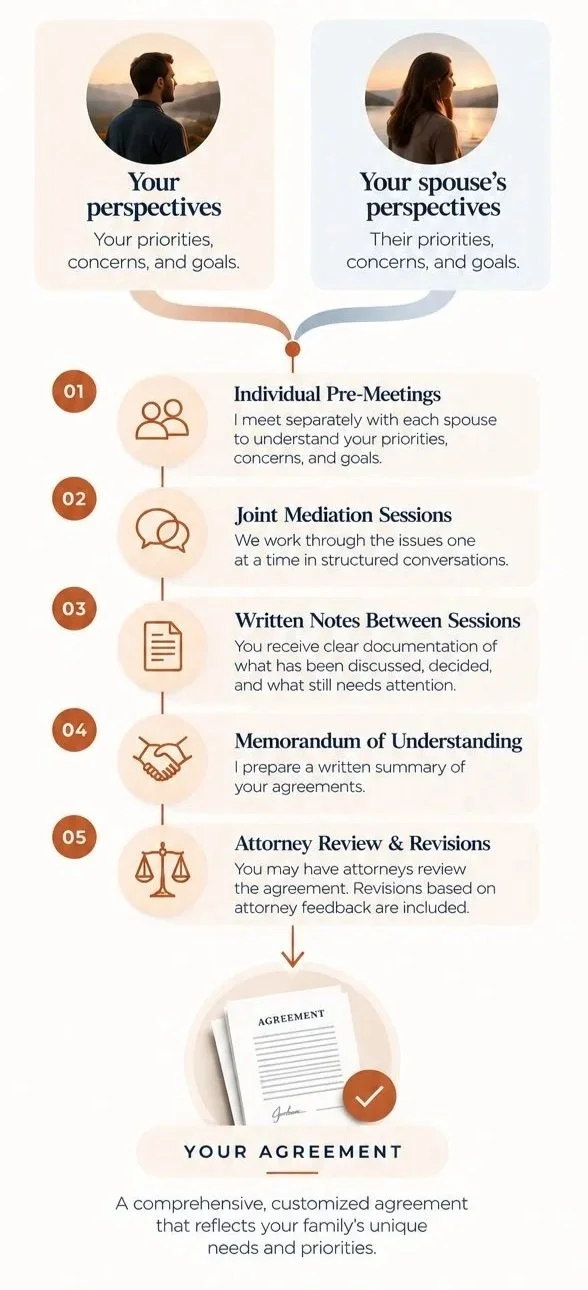
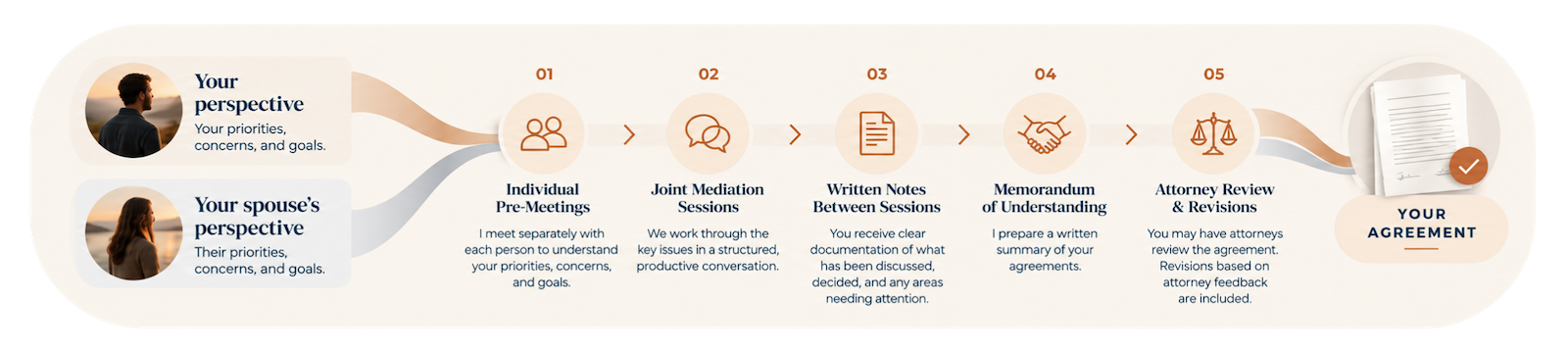
DIFFERENT PERSPECTIVES. A SHARED PATH FORWARD.
You don’t have to start in agreement.
You need a process for working through disagreement.
WHY COUPLES CHOOSE MEDIATION
More control. Less conflict. Better outcomes.
Mediation keeps decision-making primarily with the two of you rather than transferring it to attorneys, judges, or an adversarial process.

You stay in control
You make the decisions rather than having them imposed.
The process stays focused
You work through the actual issues instead of escalating every disagreement.


You preserve more privacy
Conversations and negotiations remain outside the courtroom.

You can move at a practical pace
Sessions can be scheduled around what the two of you actually need.

You protect the future relationship
Especially when you’ll continue parenting together.
Mediation works best when both people can participate meaningfully, share information honestly, and make decisions without coercion.
Divorce Mediation Package
$5,000 (flat fee)
One process, one fee, from the first mediation session through the final written agreement.
✓ Individual pre-meetings with each spouse
✓ All joint mediation sessions needed to reach agreement
✓ Written notes between sessions
✓ Preparation of the Memorandum of Understanding
✓ Revisions based on attorney feedback
✓ Referrals to attorneys for separation agreement drafting
✓ Introductions to trusted divorce professionals
✓ Up to two hours of future mediation support
The typical timeline is 4 months, though this varies based on your unique situation and availability.

THE GOAL IS PROGRESS, NOT A BATTLE.
A comprehensive agreement does not require a courtroom battle.
Mediation is a process where disagreements can be worked through productively enough to reach durable agreements that work for both of you and your family.

WHEN A FINANCIAL PROFESSIONAL BECOMES PART OF THE TEAM
Some financial questions require expertise beyond mediation.
For straightforward matters, we may be able to work through the financial issues directly in mediation. For more complex matters, I will require the involvement of a Certified Divorce Financial Analyst (CDFA).
A CDFA will generally be required when the agreement involves:
Division of retirement accounts
Refinancing or more complex home-equity decisions
Significant tax consequences
Spousal support
Child support
More complicated equitable distribution
The CDFA works alongside the mediation process and charges separately for their services.
Mediation doesn’t mean “no attorneys.”
It means using attorneys differently.
Mediation does not mean avoiding attorneys altogether. Some couples choose to consult with attorneys before, during, or after mediation for independent legal advice or document review. The difference is that attorneys support the process rather than becoming the primary vehicle through which the two of you communicate.
Mediation may be a good fit if:
You both want to avoid unnecessary litigation.
You can participate in the same process without intimidation or coercion.
You are willing to share relevant information honestly.
You can negotiate even when you disagree.
You want to preserve more control over the outcome.
Mediation may not be appropriate if:
One person cannot participate freely or safely.
There is active coercion, manipulation, or fear.
Important financial information is being concealed.
One person refuses to negotiate in good faith.
Immediate legal protection is needed.
COMMON QUESTIONS
Questions about Divorce Mediation
Here are answers to some of the most common questions I hear. If you don’t see your question here, let’s discuss it on a Divorce Mediation Consultation call.
-
Mediation itself is a process for reaching agreement. The Memorandum of Understanding documents the terms you develop together, but it is not a substitute for legal advice or formal legal documents. You may choose to have attorneys review the terms and convert them into a separation agreement or other legally enforceable documents.
-
You may. Many couples use attorneys in a limited role for legal advice, independent review, and document drafting. Mediation can reduce the amount of attorney involvement needed without eliminating legal guidance altogether.
-
That is normal. Mediation exists precisely because couples often begin with different preferences or priorities. We work through those differences one issue at a time and look for practical options both of you can live with.
-
That depends on the number and complexity of the issues, how prepared both spouses are, and how quickly decisions can be made. Some couples move through the process relatively quickly; others need more time between sessions.
-
When specialized financial analysis is needed, I will recommend or require the involvement of a Certified Divorce Financial Analyst. Their work is separate from the $5,000 mediation fee.
-
Yes. Attorneys can remain involved as advisors while you use mediation to work through the substantive issues together.

TAKE THE NEXT STEP
Explore whether mediation could work for your situation.
The first step is a Divorce Mediation Consultation call. We’ll talk through where you are, what you’re hoping to achieve, and whether mediation is a good fit for your unique circumstances.