
How to Know Whether Divorce Is the Right Decision
Few decisions in life carry as much emotional weight as deciding whether to end a marriage. If you’ve found yourself searching online for answers, chances are you’re not looking for a quick opinion—you’re looking for clarity.
By: James Traub • Updated: July 2026

There comes a point in many struggling marriages when one question begins to crowd out every other thought:
Should I stay, or is it time to leave?
For some people, that question arrives after years of unresolved conflict. For others, it follows a betrayal, growing emotional distance, or the realization that the relationship no longer feels healthy or sustainable. Sometimes it emerges quietly, surfacing during a difficult conversation or another sleepless night when you find yourself wondering, Is this really how the rest of my life is going to feel?
If that’s where you are today, you’re not alone.
As a divorce coach and mediator, I’ve had the privilege of walking alongside many individuals and couples during this stage of uncertainty. One thing I’ve learned is that very few people arrive at this question lightly. By the time someone begins searching online for answers, they’ve often spent months—or even years—wrestling with the decision internally.
And yet, the internet rarely offers the kind of guidance people actually need.
One article insists you should fight for your marriage at all costs. Another suggests that if you’re unhappy, it’s time to move on. Friends and family often have strong opinions based on their own experiences, values, or loyalties. Even well-intentioned advice can leave you feeling more conflicted than before.
The truth is that no article, coach, therapist, attorney, or friend can tell you whether divorce is the right decision for your family.
But there is a better way to approach the question.
Not by searching for certainty.
Not by waiting for one dramatic moment that makes the answer obvious.
But by slowing down, asking thoughtful questions, and making one of life’s biggest decisions with greater intention and clarity.
Why This Decision Feels So Overwhelming
Deciding whether to divorce isn’t simply a relationship decision.
It’s dozens of decisions wrapped into one.
You’re not only asking whether your marriage can survive—you’re also thinking about your children, your finances, your home, your identity, your future, your holidays, your friendships, your routines, your hopes for what life was supposed to look like…
It’s no wonder people often feel stuck.
Many individuals describe feeling as though they’re standing at a crossroads where neither path feels easy.
Stay—and risk years of continued disappointment, loneliness, or conflict.
Leave—and face uncertainty, grief, financial change, and the possibility of hurting the people you love most.
When viewed that way, it’s understandable why people often remain in limbo. Our brains are naturally wired to avoid loss and uncertainty. Faced with two difficult options, many of us default to making no decision at all.
Unfortunately, remaining stuck can become its own kind of decision.
Months become years.
Conversations become repetitive.
Hope gradually gives way to resignation.
The goal isn’t to rush toward divorce.
Nor is it to remain in an unhealthy relationship indefinitely.
The goal is to arrive at a thoughtful decision you can look back on years from now and know you approached with honesty, care, and integrity.
Clarity rarely arrives all at once. More often, it develops one honest conversation, one thoughtful reflection, and one intentional decision at a time.

Avoid the Trap of Looking for Certainty
One of the most common things I hear is:
“I just wish I knew what the right decision was.”
It’s a completely understandable feeling.
We naturally want certainty before making a life-changing choice.
But certainty is rarely available when we’re making our biggest decisions.
Think about other significant moments in life:
Accepting a new job.
Moving across the country.
Having children.
Starting a business.
No one can guarantee how those decisions will unfold.
Marriage—and divorce—are no different.
Waiting until you’re 100% certain often means waiting forever.
Instead of asking,
“Can I become completely certain?”
a better question might be,
“Am I making this decision thoughtfully, intentionally, and for the right reasons?”
That’s a very different standard.
And it’s one that’s actually attainable.
A Different Way to Think About Divorce
One of the biggest shifts I encourage clients to make is this:
Stop asking only,
“Should I get divorced?”
Begin asking,
“What future am I trying to create?”
That simple shift often changes everything.
Instead of becoming trapped in arguments about who’s right or wrong, you begin evaluating whether your current relationship—and your current patterns—are moving you toward the kind of future you hope to build.
For some couples, that future is still possible together.
For others, the healthiest path may involve separating while preserving respect, cooperation, and a strong co-parenting relationship.
The question isn’t simply whether your marriage is difficult.
Every marriage encounters difficult seasons.
The deeper question is whether the relationship can realistically become healthy enough to support the life you’re hoping to create.
That requires reflection—not reaction.
Five Common Mistakes People Make When Deciding About Divorce
When emotions are running high, it’s easy to look for quick answers. Unfortunately, some of the most common ways people approach this decision can leave them feeling even more uncertain—or lead them to make choices they later regret.
Here are five traps I encourage people to watch for:
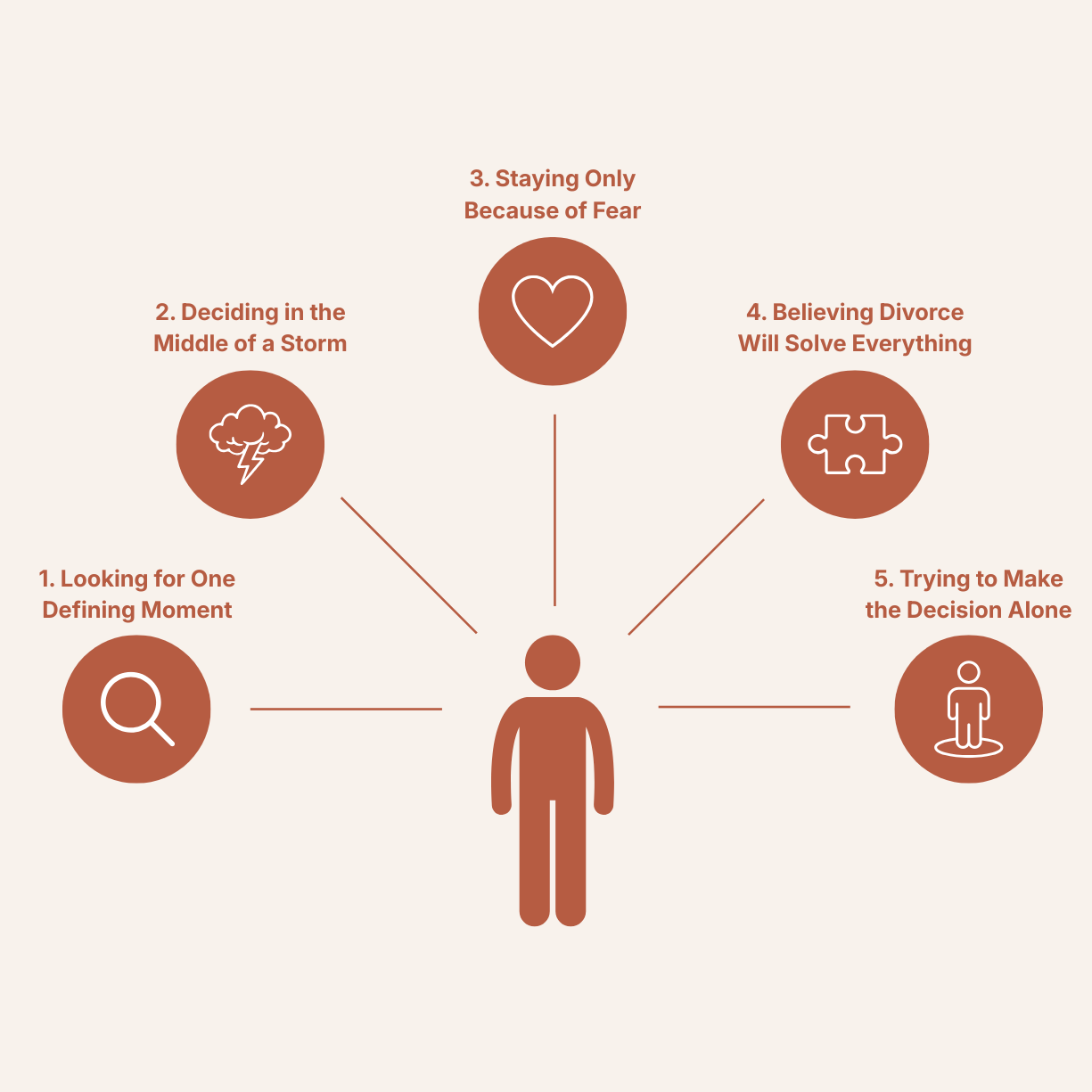
1. Looking for One Defining Moment
Many people believe there will eventually be a moment when everything suddenly becomes clear.
One final argument.
One undeniable realization.
One event that removes every doubt.
Sometimes that happens.
More often, it doesn’t.
The decision to divorce is usually the result of many experiences accumulating over time rather than one dramatic event. Waiting for absolute certainty can keep people stuck long after they already understand what needs to change.
Instead of waiting for one decisive moment, pay attention to the overall direction of your relationship.
Ask yourself:
Are we moving toward greater connection and understanding—or further apart?
2. Making a Decision in the Middle of a Storm
Conflict changes the way we think.
During an argument—or immediately after a betrayal or painful conversation—our nervous system becomes focused on protection rather than thoughtful decision-making.
In those moments, it’s tempting to make permanent decisions based on temporary emotions.
That’s rarely helpful.
If you’re considering divorce, give yourself enough emotional space to distinguish between reacting to today’s pain and thoughtfully evaluating the future of your relationship.
The goal isn’t to eliminate emotion.
It’s to avoid allowing emotion to make the decision for you.
3. Staying Only Because You’re Afraid
Fear has an important role.
It reminds us that divorce is a significant decision with real consequences.
But fear isn’t always a reliable guide.
People stay because they’re afraid of hurting their children.
They’re afraid of financial uncertainty.
They’re afraid of being alone.
They’re afraid they’ll regret leaving.
Others leave because they’re afraid nothing will ever change.
The question isn’t whether fear exists.
The question is whether fear is driving the decision.
Healthy decisions are usually guided by values rather than fear.
4. Believing Divorce Will Solve Everything
It’s understandable to imagine divorce as the end of conflict.
Sometimes it is.
Often, it simply changes the nature of the challenges you’ll face.
Divorce doesn’t automatically heal communication patterns.
It doesn’t remove the need to co-parent.
It doesn’t erase grief or uncertainty.
If children are involved, your relationship as spouses may end, but your relationship as parents will continue for years to come.
That’s why it’s important to think beyond the divorce itself.
What kind of relationship do you hope to have with one another afterward?
What example do you want to set for your children?
What would you like life to look like five years from now?
Keeping that future in mind often leads to very different decisions in the present.
5. Trying to Make the Decision Alone
One of the most difficult parts of this process is how isolating it can feel.
Many people hesitate to tell friends or family because they don’t want to be judged.
Others worry that once they say the words out loud, they’ll somehow be committed to divorce.
As a result, they carry enormous emotional weight alone.
Sometimes simply having a thoughtful conversation—with a therapist, coach, trusted friend, or mentor—can help untangle thoughts that have been swirling around for months.
Not because someone else tells you what to do.
But because speaking honestly often brings clarity that thinking alone cannot.
The goal isn’t to make the fastest decision. It’s to make the most thoughtful one.

7 Questions That Can Help You Gain Clarity
If you’re wrestling with this decision, here are seven questions I encourage you to spend time reflecting on.
These aren’t intended to produce immediate answers.
They’re meant to help you slow down and explore the bigger picture:
1. Have we genuinely tried to repair the relationship?
Every marriage goes through difficult seasons.
The question isn’t whether you’ve struggled.
The question is whether meaningful efforts have been made to address those struggles.
Have honest conversations taken place?
Have boundaries been discussed?
Have counseling or other forms of support been considered?
Have both partners demonstrated a willingness to grow?
Understanding what has—and hasn’t—been tried can provide valuable perspective.
2. If nothing changed over the next five years, how would I feel?
This question often shifts the conversation.
Rather than focusing only on today’s emotions, imagine that your relationship remains exactly as it is now.
No better.
No worse.
How does that future feel?
Does it bring peace?
Sadness?
Relief?
Resignation?
Your answer may reveal more than you expect.
3. What am I hoping will be different?
It’s easy to become focused on escaping what’s painful.
Instead, spend some time imagining what you’re actually moving toward.
What kind of relationship do you hope to have?
What kind of home environment?
What kind of parent do you want to be?
Clarity grows when we define the future we’re hoping to create—not just the present we’re hoping to leave behind.
4. Am I reacting to a season, or responding to a pattern?
Every relationship experiences difficult periods.
Stress at work.
Health concerns.
Parenting challenges.
Financial strain.
The important distinction is whether those challenges represent a temporary season—or a long-standing pattern that has remained unchanged despite repeated efforts.
Patterns deserve attention.
Seasons deserve patience.
Learning to tell the difference is one of the most valuable parts of this process.
5. What role have I played in where we are today?
This is often the hardest question.
It’s also one of the most freeing.
Healthy reflection isn’t about assigning blame.
It’s about taking ownership.
Every relationship is shaped by two imperfect people.
Regardless of what happens next, understanding your own patterns creates opportunities for growth that will benefit every future relationship—including your relationship with your children.
6. What would I hope my children say about how I handled this someday?
If you’re a parent, this question has a way of bringing everything back into focus.
Children may not remember every conversation.
They will remember how the adults around them treated one another.
Years from now, what do you hope your children would say about the way you navigated this chapter?
That question often becomes a compass for the decisions that follow.
7. What decision would align most closely with the person I want to become?
This may be the most important question of all.
Instead of asking,
“What feels easiest today?”
Ask,
“What choice best reflects my values, my integrity, and the future I’m hoping to create?”
That doesn’t necessarily make the decision easier.
But it often makes it clearer.

Pause & Reflect
Take a few quiet minutes. Which question above stands out most to you right now, and why? Grab some paper and start exploring your answers. You might be surprised by the clarity that emerges.
Sometimes Clarity Doesn’t Mean Certainty
One of the greatest misconceptions about major life decisions is that clarity and certainty are the same thing.
They aren’t.
Certainty suggests there are no doubts.
No questions.
No sadness.
No fear.
Life rarely works that way.
Clarity is different.
Clarity is reaching a place where, despite the uncertainty, you understand your reasons.
You’ve reflected carefully.
You’ve considered the impact on the people you love.
You’ve examined your hopes, your fears, your values, and your vision for the future.
You may still grieve.
You may still worry.
But you’re no longer simply reacting.
You’re making a thoughtful decision.
And that’s something you can carry with you long after this chapter of your life has ended.
Reading Creates Awareness. Reflection Creates Clarity.
If you’ve made it this far, you’ve probably realized something.
The question,
“Should I get divorced?”
doesn’t have a simple yes-or-no answer.
It’s a deeply personal decision—one that deserves more than a late-night Google search or a collection of opinions from friends, family, or strangers online.
My hope is that this article has helped you slow down, consider some new perspectives, and begin asking better questions.
But reading and reflecting are two different things.
Understanding an idea intellectually isn’t the same as applying it to your own marriage, your own family, and your own future.
That’s where many people get stuck.
They understand what they should be thinking about, but they don’t have a process for actually thinking it through.
That’s exactly why I created the Is Divorce the Right Decision? Workbook.
A Guided Process for One of Life’s Biggest Decisions
Rather than giving you advice or telling you what decision to make, this workbook is designed to help you organize your own thoughts through a series of structured reflections and exercises.
Inside, you’ll explore questions such as:
Is this relationship repairable?
Have we truly exhausted opportunities for change?
What patterns have brought us to this point?
What fears are influencing my thinking?
What kind of future am I hoping to create?
How might each path affect my children, my relationships, and my own well-being?
More importantly, you’ll have space to write.
To pause.
To reflect.
To notice patterns you may not have seen before.
Because clarity often emerges through the process of thinking—not simply through consuming more information.
The goal isn’t to help you decide quickly. It’s to help you decide thoughtfully.
Is Divorce the Right Decision? Workbook
A step-by-step guide to help you thoughtfully evaluate your relationship, clarify your priorities, and make one of life’s biggest decisions with greater confidence and less regret.
YOUR NEXT STEP

Guided reflection exercises

Decision-making frameworks
Questions to explore individually or with your spouse
Journaling prompts
Space to organize your thoughts
✓ Instant Download
✓ Use at your own pace
✓ Private & confidential

You Don’t Have to Figure This Out Alone.
Sometimes the most valuable thing isn’t an article. It’s a thoughtful conversation. If you’d like to talk through your specific situation or explore whether divorce coaching or mediation could be helpful, I’m here to help.
No pressure. Just a conversation.