Pro Se Mediation vs. Traditional Divorce Mediation: What’s the Difference?

Many people are surprised to learn that “divorce mediation” can mean two very different processes.
If you’ve started researching divorce, you’ve probably come across the term mediation more than once.
Perhaps an attorney recommended it.
Maybe a friend told you they “went through mediation.”
Or perhaps you’re simply looking for an alternative to a traditional courtroom divorce.
The challenge is that the word mediation is often used to describe two very different processes.
Understanding that distinction can help you choose the approach that’s the best fit for your family, your goals, and the kind of divorce experience you’re hoping to have.
Not all divorce mediation is the same. The process—and your experience—can look very different depending on when mediation occurs and how it’s structured.
What Is Traditional (Pre-Trial) Mediation?
Traditional divorce mediation usually takes place after the legal process has already begun.
By this point:
One or both spouses have hired attorneys.
Legal documents have been filed.
Attorneys have exchanged information and negotiated.
One or more issues remain unresolved.
A court date may already be scheduled.
The purpose of mediation is to determine whether those remaining disputes can be resolved before trial.
In many cases, each spouse remains in a separate room with their attorney while the mediator moves back and forth between rooms, carrying offers and counteroffers.
For many families, this process is appropriate and effective.
Especially when litigation is already underway or the legal issues are particularly complex.

What Is Pro Se Mediation?
Pro se simply means that each person is participating without an attorney negotiating on their behalf.
Instead of preparing for court, spouses work directly with a neutral mediator to reach agreements together.
The goal isn’t to determine who wins.
It’s to help both people work through the practical decisions that need to be made so they can move forward.
Those conversations often include:
Parenting arrangements
Division of assets and debts
Financial support
The marital home
Future communication
Building a comprehensive separation agreement
Attorneys can still play an important role.
Many couples choose to meet with consulting attorneys throughout the process or have an attorney review their final separation agreement before signing.
The difference is that the conversations themselves happen directly between the spouses, with the mediator guiding the discussion.
Rather than preparing for litigation, pro se mediation focuses on preparing for life after divorce.
A Side-by-Side Comparison
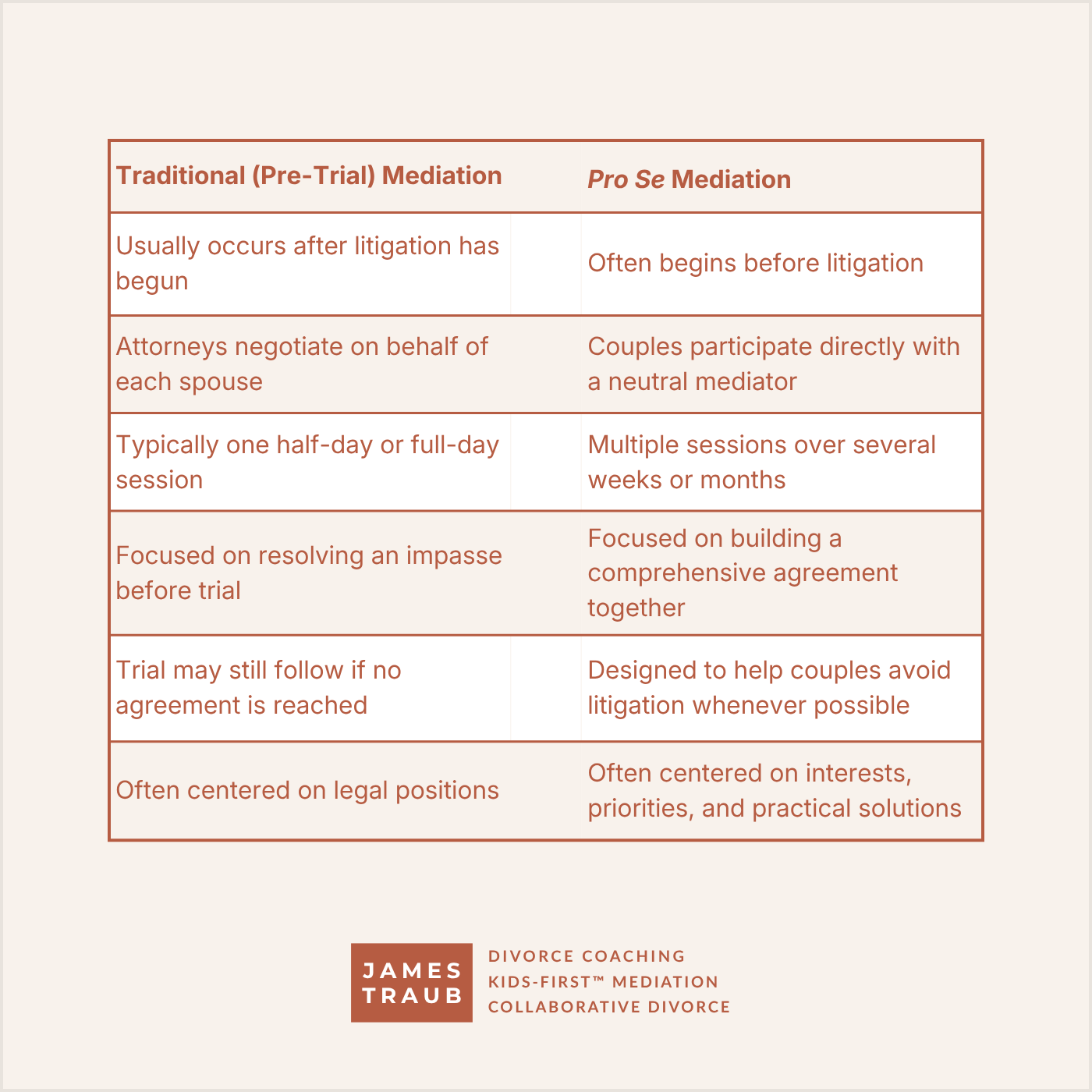
Neither approach is inherently better.
They’re simply designed for different situations and different stages of the divorce process.
The Pace of the Process Matters
One of the biggest differences between these two models isn’t just who is in the room.
It’s how the work gets done.
Traditional pretrial mediation is designed to resolve a dispute that’s already reached an impasse.
By the time mediation occurs:
Attorneys have often been negotiating for months.
Positions may already be firmly established.
A trial date may be approaching.
Everyone hopes an agreement can be reached before court.
As a result, mediation is often scheduled as a single half-day or full-day event.
There’s naturally a sense of urgency.
If agreements aren’t reached, the next step is often continued litigation—with the additional time, stress, and legal expense that can follow.
Pro se mediation is built differently.
Instead of trying to resolve every issue in one long session, couples work through decisions over time.
Rather than asking,
“Can we settle everything today?”
the question becomes,
“What’s the next conversation we need to have?”
That shift changes the experience dramatically.
Pro se mediation isn’t designed around one important day. It’s designed around a series of thoughtful conversations.
One Conversation at a Time
In my mediation process, couples typically meet for weekly or bi-weekly sessions, working through one topic at a time.
Rather than rushing through every issue, we focus on making steady progress toward a comprehensive separation agreement.
One session might focus on parenting.
The next might focus on financial information.
Another might address:
Property division
Support
Retirement accounts
Future communication
Remaining questions
Each meeting builds on the last.
Between sessions, couples have time to:
Gather additional information.
Reflect on possible solutions.
Consult with attorneys or financial professionals if needed.
Return ready for the next conversation.
That slower pace often allows people to make more thoughtful decisions than they can during a single day of negotiation.
The Goal Is Different
Traditional mediation often asks:
“Can we resolve this dispute before trial?”
Pro se mediation asks:
“How do we build a complete agreement that both people understand and can live with?”
Those are different objectives.
One is primarily focused on resolving an existing legal dispute.
The other is focused on helping couples thoughtfully work through every major issue involved in ending a marriage.
Neither approach is inherently better.
But understanding the difference helps couples choose the process that best fits their situation.
Traditional mediation is often about resolving a dispute. Pro se mediation is about building an agreement.

What About Attorneys?
This is one of the biggest misconceptions about pro se mediation.
Some people assume choosing mediation means they can’t consult an attorney.
That’s simply not true.
Many couples choose to:
Meet with an attorney before mediation to better understand their legal rights.
Consult an attorney between mediation sessions.
Have an attorney review their final separation agreement before signing.
Ask legal questions throughout the process as needed.
Rather than replacing attorneys, pro se mediation often allows attorneys to be used more intentionally—providing legal advice without requiring them to negotiate every decision.
For many couples, mediation isn’t about avoiding attorneys. It’s about using each professional for what they do best.
A Kids-First™ Perspective
For parents, mediation isn’t simply about reaching agreements.
It’s about creating the foundation for years of future co-parenting.
That’s why my mediation process is guided by a Kids First™ approach.
Throughout our conversations, we’ll regularly come back to questions like:
What arrangement best supports your children’s long-term well-being?
How can we reduce unnecessary conflict?
What decisions will strengthen your future co-parenting relationship?
What will your children be most grateful for years from now?
Your children won’t be present in mediation.
But their future remains an important part of every parenting discussion.
The agreements you reach today don’t simply resolve today’s questions.
They help shape your family’s experience long after the divorce is finalized.
The best mediation agreements aren’t simply legally workable. They’re practically workable for the family that’s going to live with them.

Which Approach Is Right for You?
Traditional pretrial mediation may be appropriate if:
Litigation has already begun.
There are significant legal disputes.
One or both spouses already have attorneys actively negotiating.
The court has ordered mediation before trial.
Pro se mediation may be a good fit if:
Both spouses are willing to participate in good faith.
You’d like to avoid unnecessary litigation if possible.
You want greater control over the outcome.
You prefer working through decisions together rather than through opposing attorneys.
You’re looking for a more collaborative, child-centered process.
The right choice depends on your circumstances, your goals, and the level of collaboration that’s possible between you.
Understanding your options is often the first step toward making a confident decision.
Still Wondering Which Path Is Right for You?
Choosing how to navigate your divorce is one of the earliest—and most important—decisions you’ll make.
If you’re exploring mediation and wondering which approach makes the most sense for your situation, I’d be happy to help you think through your options.
There’s no pressure to commit to a particular process.
Sometimes the most valuable first step is simply understanding the available paths so you can make informed decisions about what comes next.